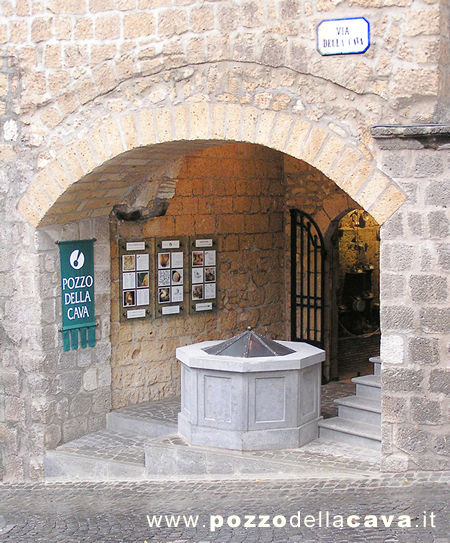
The hill towns of Umbria and Lazio sit on geology that made water management both urgent and technically demanding. Perched on volcanic tufa plateaus or limestone ridges, settlements like Todi, Orvieto, Perugia, and Viterbo had no reliable access to surface rivers. Roman engineers solved this problem with aqueduct branches and underground cisterns; their medieval successors inherited the infrastructure, adapted it, and in many cases expanded it. The result is a layered underground record spanning more than fifteen centuries of continuous water engineering.
Todi: The Most Extensively Documented System
Todi, a hill town in southern Umbria, contains the most comprehensively recorded subsurface cistern network in the region. Beneath its central Piazza del Popolo, urban speleologists from the Todi Speleological Group, working in collaboration with Umbria's Archaeological Authority, have documented more than 30 cisterns and over 500 wells of varying periods — pre-Roman, Roman, and medieval — alongside approximately 5 kilometres of connecting tunnels and galleries.
The principal Roman cistern complex consists of two separate groupings: the eastern complex, situated beneath the Palazzo dei Priori, and the western complex, running under the piazza itself. Each grouping contains twelve rectangular chambers constructed in opus caementicium — the Roman concrete standard for waterproof underground construction. The dimensions of each chamber are consistent: approximately 8 metres high, 8 metres wide, and 30 metres in length, with a barrel-vault ceiling. Combined storage capacity across both complexes reaches 30,000 cubic metres. Construction traces visible on the chamber walls include impressions left by the wooden formwork used to shape the vaults, a detail that allows approximate construction sequencing through comparison with known Roman building methods.
The eastern complex was first documented administratively in 1262, when it appears in municipal records as a functioning water source beneath the Palazzo dei Priori. This date establishes a minimum age for medieval awareness of the Roman structure, though actual medieval modifications to the cistern fabric are difficult to isolate from later interventions without systematic material analysis. Recent restoration work by the municipal authority made twelve of the western chambers directly accessible to visitors, with interpretive materials produced in cooperation with the Soprintendenza dell'Umbria. Full details are available through Exploring Umbria.
Construction Method: Tufa and Vault
The distinctive geology of Umbrian and Lazian hill towns shaped construction throughout. Tufa — the generic Italian term for consolidated volcanic ash deposits — is soft enough to cut with iron tools and yet durable enough, once sealed, to hold water without constant maintenance. Roman builders exploited this combination consistently: cistern walls were cut or built into tufa bedrock, then lined with cocciopesto, a hydraulic plaster composed of crushed terracotta mixed with lime. Cocciopesto develops a slight crystalline structure on its surface as it cures, self-sealing minor cracks and remaining waterproof for centuries without reapplication.
Vault construction above the cistern chambers required precise form-work. Timber centring was assembled inside the chamber, the vault arch was built over it in stone and mortar, and the centring was struck once the arch had set. The vault's geometry — a simple semicircular barrel — distributed lateral thrust into the chamber walls rather than downward, reducing the load on the cistern floor and allowing the space beneath the vault to remain free for water storage.
Medieval builders working in the same towns adapted this vocabulary with local modifications. Where Roman cisterns used consistent modular chamber sizes, medieval cisterns in Umbria show more variation, often shaped to fit within existing building footprints or around earlier underground voids. Some medieval cisterns in Orvieto are carved entirely into the tufa plateau without any masonry superstructure — the rock itself forming all four walls, the floor, and a vaulted ceiling cut by hand.
Orvieto and the Pozzo della Cava
Orvieto sits on a flat-topped butte of tufa rising approximately 100 metres above the surrounding plain. The plateau's geology made it easily defensible but chronically short of surface water. Over the course of more than two millennia, the community carved an estimated 1,200 caves, wells, cisterns, cellars, and connecting passages into the tufa — a density of underground space that makes Orvieto one of the most intensively excavated urban subsurfaces in Italy.
The Pozzo della Cava, one of the more thoroughly documented individual complexes, spans occupational periods from the Etruscan era through the Renaissance. Its central shaft descends 36 metres, with notches cut into the walls at intervals — the pedarole used by workers to climb in and out before the installation of mechanical lifting equipment. The complex was documented administratively from the medieval period but fell out of direct use and was partially sealed. Rediscovery came in 1984 during renovation work on the building above. In 2023, Pozzo della Cava was formally included in the UNESCO-IHP Global Network of Water Museums, a recognition of its value as a documented example of long-term water management in a confined urban geological environment.
Water Supply Logic in Hill Town Settings
Understanding why cisterns dominated Umbrian and Lazian hill towns requires attention to the hydrological constraints specific to volcanic plateau geology. Surface springs are rare at altitude; where they occur, they are often seasonal and insufficient for urban populations. Rivers are distant and at lower elevation, making aqueduct construction expensive and politically complex — each kilometre of stone channel required legal access to land parcels, regular maintenance staffing, and vulnerability to seasonal flooding or deliberate sabotage in times of conflict.
Cisterns, by contrast, were self-contained and defensible. A town with adequate cistern capacity could sustain a siege far longer than one dependent on external water supply. Medieval accounts of sieges in Umbria frequently reference the capacity of town wells as a determining factor in the outcome — Orvieto, for example, commissioned the construction of its Pozzo di San Patrizio (designed by Antonio da Sangallo the Younger for Pope Clement VII in 1527) specifically as a response to the trauma of the 1527 Sack of Rome, which demonstrated how rapidly an urban population could be reduced to critical water shortage.
Dual-Source Engineering
The most sophisticated cistern systems in the region used dual water sources. Rainwater, collected from roof surfaces and courtyard pavings through terracotta channel systems, entered the cistern through apertures in the vault. Spring water, where accessible, was channelled from the hillside through underground conduits and added directly. The two sources required different filtration approaches: rainwater carried organic debris and required settling chambers, while spring water often carried dissolved minerals that, over time, deposited calcite on cistern walls and reduced effective storage volume.
The eastern Todi complex used both methods, with vault apertures admitting rainwater and a separate feeder line drawing from a hillside spring documented in 13th-century municipal records. Seasonal variation in supply was managed by the cistern's depth — deeper chambers maintained cooler temperatures, reducing evaporation losses in summer months when rainfall was least reliable.
Sources: Exploring Umbria — Todi Roman Cisterns; Hotel Fonte Cesia — Cistern History; Umbria Tourism — Pozzo della Cava.